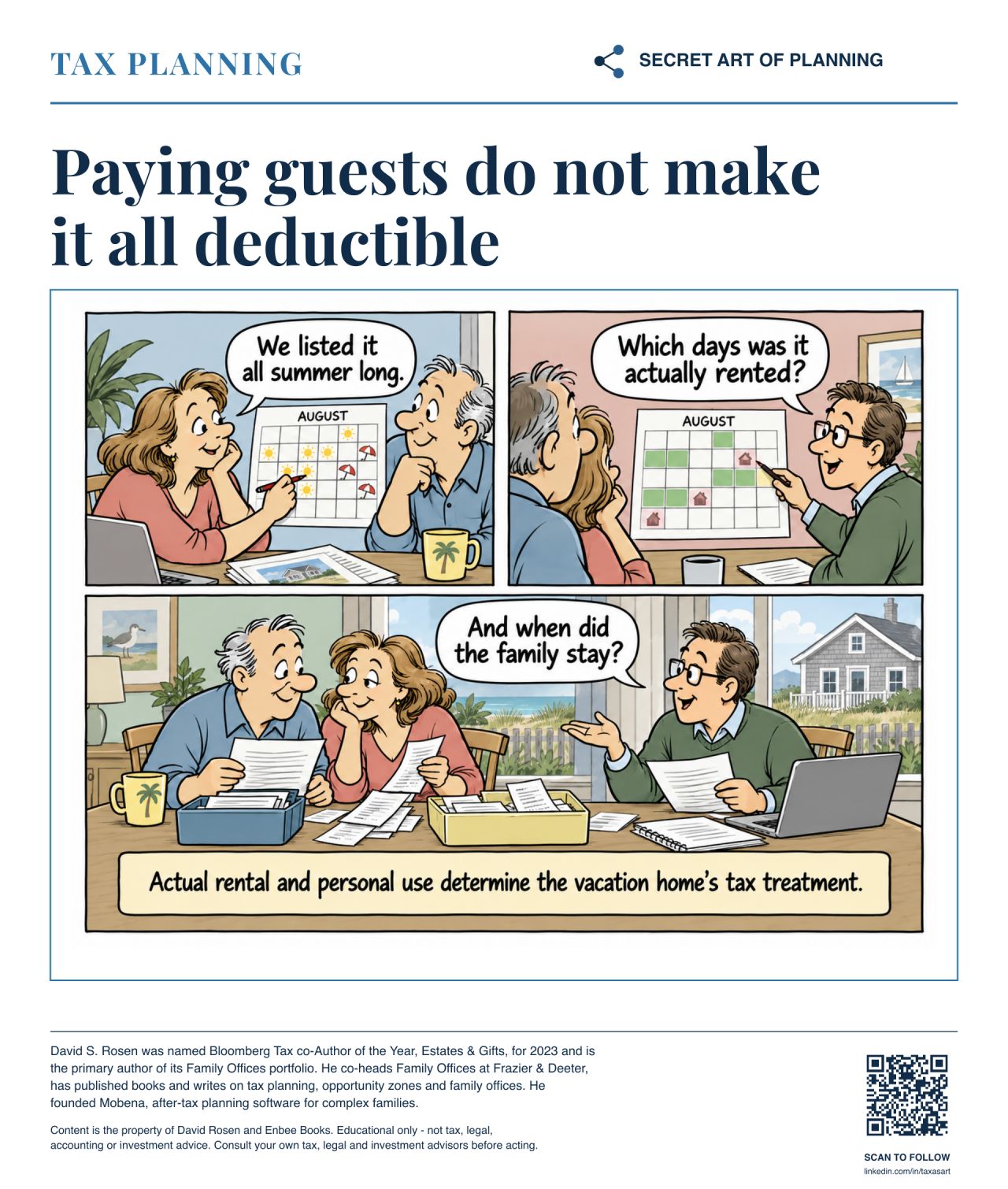
Paying guests do not make it all deductible
Personal costs do not become rental deductions just because a vacation home has paying guests. Before choosing how many weeks to rent it, compare the rent the family will keep after expenses and tax with the personal use it is giving up.
A dwelling is treated as a residence under §280A if personal use exceeds the greater of 14 days or 10% of the days it is rented at a fair rental price. It is not enough to satisfy whichever number is smaller.
Personal use includes more than the owner's vacations. Use by family members, certain co-owners, home-exchange arrangements and below-market rentals can count. A family member's use as a principal residence at a fair rent can qualify for an exception. Full-time repair and maintenance days also have a specific rule.
Merely offering the home for rent does not make a vacant day a rental day.
If the dwelling is used as a residence and is actually rented for fewer than 15 days during the year, the rental income is excluded from gross income and no deduction attributable to the rental use is allowed. Expenses otherwise deductible remain subject to their own rules.
If it is used as a residence and rented for 15 days or more, rental income is reportable and expenses must be allocated between rental and personal use.
Operating costs and depreciation attributable to rental use can be deductible, but the residence-use limitation generally prevents those deductions from creating a rental loss. The deduction ordering rules, otherwise allowable interest and taxes, and carryforwards require separate calculations. Personal costs do not become deductible simply because the home had paying guests.
A family may instead convert the property to rental use.
For depreciation, the property's starting basis on conversion generally is the lower of adjusted basis or fair market value at conversion, with land excluded from depreciable basis. A decline in value while the home was personal-use property does not become a deductible rental loss merely by changing its use. A later sale has separate gain and loss basis rules.
For a valuable or unusual residence, the conversion-date valuation can have significant consequences. The use records and support for fair rental value matter as much as the rent deposits.
The family’s use first determines whether §280A limits the deductions as a residence. If a rental loss remains, the passive-activity and other limits determine whether the owner can use it.